The Climate Finance Files Methodology
This page was last updated on 4 December 2023
Climate finance data is notoriously difficult to access and understand. The different reporting systems, methodologies, sources, and types of finance can make it hard to provide straightforward answers to key questions.
We started this work to quantify annual climate finance contributions by specific countries. But asking a question as simple as "How much does France spend on mitigation and adaptation in developing countries?" raised a myriad of questions: According to which source? Commitments or disbursements? Grants or loans? ODA or other official flows? Bilaterally or multilaterally... and so on.
Finding answers to these questions isn't easy. Different organisations have different motivations for how they report and present this data. And analysing climate finance in a robust way requires going back to messy and complex raw data.
We realise that many organisations have a strong track record of analysing climate finance data. We have learnt a lot from that work.
But we think that accessing clean, comparable data on climate finance should be much easier than it is now.
As part of this work, we are releasing tools to more easily extract, clean, and work with the data reported to UNFCCC and the OECD, without relying on the many individual spreadsheets and databases where it is currently stored.
We are also making clean versions of the data available for others to analyse. This should meaningfully lower the barriers to access that many organisations face when seeking to conduct research or advocacy on these topics.
TL;DR
All climate data is pretty terrible. But we think The Climate Finance Files data is better and more comparable than anything else publicly available.
We provide estimates of climate finance using the latest, most granular, publicly available climate finance data. We apply a consistent methodology to minimise overcounting and to more clearly distinguish between adaptation and mitigation financing. And, where possible, we focus on disbursements (money actually provided) instead of commitments (the intention to provide money).
What is climate finance?
The Climate Finance Files look specifically at international public financial support for climate change adaptation and mitigation.
That's a mouthful, but an important one.
International public climate finance refers to public money going from provider countries and multilateral institutions to (developing country) recipients. That means it doesn't include things that aren't money, domestic spending, or money for other purposes outside mitigation and adaptation.
Is it the same as climate finance counted towards the US$100 billion goal?
It's part of it... but not all of it.
In 2009, developed countries committed to jointly mobilise US$100 billion annually in climate finance by 2020 to support developing countries in reducing emissions and adapting to climate change.
They didn't define that objective very well: there is no universally agreed definition of what exactly1 counts and what doesn't, or how to count it.
At a minimum, the goal includes mobilised private finance and export credits, which The Climate Finance Files don't (yet) track.
How do we count it?
An innovation of The Climate Finance Files is applying the same methodology for all providers.2 That means our data is comparable across providers.
We standardise what providers report in three main ways:
- To reduce over-counting (what we sometimes call inflation), for Rio Markers data we count 100% of the value of projects with a principal focus on climate change, and 40% of the value of projects with a significant climate focus.
- We split climate finance into adaptation, mitigation, and cross-cutting finance. We do that by attributing projects to the 'highest' marker used by providers,3 and counting them as cross-cutting when both markers are equal. As a nice side-effect, this eliminates double counting.4
- We strongly favour disbursements. A lot of our number crunching was to figure out how much is actually being spent. The Climate Finance Files, however, also include commitments data.
1. Reducing Rio Markers inflation
The Rio Markers were not designed to report flows... but they often are, in ways that inflate how much is being provided (see below for more).
To address this, for providers that use the Rio Markers to track and report climate finance:
The Climate Finance Files count 100% of the value of projects with a principal focus on climate change, and 40% of the value of projects with a significant focus, as explained in more detail above.
Counting 40% of significant projects (instead of 100%) likely doesn't entirely eliminate inflation. It's also quite arbitrary.
Our objective is to ensure maximum comparability across providers. We know this doesn't eliminate the inflation that may happen for "principal" projects — but there is no common practise for discounting those activities. We also know that 40% may be overly generous in some cases, and perhaps miserly in cases when providers are very conservative with their Rio marking.
Counting 100% of the value of projects using the Rio markers results in overcounting
Use the sliders to choose how much to count of each type of project.
Note: this chart takes into account only climate finance reported to the OECD through the Creditor Reporting System (CRS) database. Projects reported only to the Climate-related Development Finance (CRDF) database, which are missing key information, are excluded. Only providers who use the Rio Markers are included.
The alternative would be to assess how much of each project is spent on climate change. But only providers can do that, and they mostly don't (only a few do it when reporting to the United Nations Framework Convention on Climate Change, or UNFCCC).
Given how crucial climate finance data is, it's rather incredible that there aren't better, universally accepted standards.
We count only 40% of significant projects because:
- It is better than just counting 100%
- It is a fairly common percentage used when reporting to the UNFCCC.
- Data that calculates a percentage for each project is not available for most providers.5
The current system used to track spending on climate adaptation and mitigation is antiquated and inadequate.
The Rio Markers were introduced to the OECD Development Assistance Committee (DAC) statistical systems in 1998 to identify projects targeting the 1992 Rio Conventions. They were not designed to track flows. Instead, they were designed to identify projects.6 But in practise, they are being used to track flows.
When climate finance data is presented in the OECD databases,7 the entire value of commitments for projects marked as principal or significant using the Rio Markers is counted as climate finance.
And when providers report data to the UNFCCC, they choose how much of each marker they count as climate finance.
Here's an overview of how messy that can get.
The climate share of each project should be assessed on a case-by-case basis
That rarely happens....
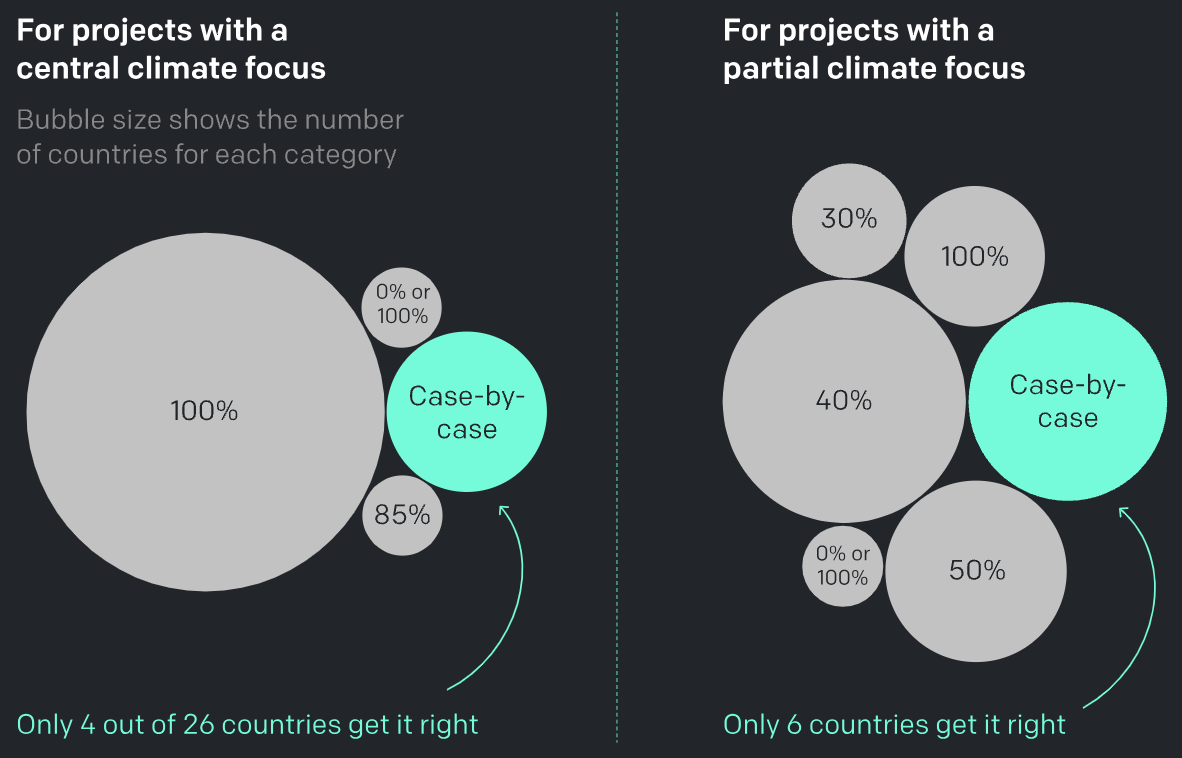
This chart shows how providers report to the UNFCCC. 100% means that the entire value of a project marked as principal or as significant is counted as climate finance. Case-by-case means the provider estimates how much of a project's value is actually for climate change adaptation or mitigation.
2. Tracking the "highest" marker
Understanding how much finance is targeting adaptation and mitigation is key. But the current system makes that task confusing and problematic.
A project can be marked as "principal"8 or "significant"9 for adaptation or mitigation, or both.10 Given how markers work, any permutation is possible.
That means a project can be marked, for example, "principal" for mitigation and "significant" for adaptation. Or "not targeted" for mitigation and "significant" for adaptation. Or "principal" for adaptation and "principal" for mitigation... and so on.
Without finding a way to disentangle the data, adding all adaptation and all mitigation data can result in double counting. That is because the same project can be for both adaptation and mitigation.11
The Climate Finance Files follow a highest marker approach when allocating funding between adaptation, mitigation, and cross-cutting climate finance.
That means that we assign the value of a project to whichever marker is the highest ("principal" is higher than "significant," which is higher than "not targeted"). When the project is marked the same way for both adaptation and mitigation, it becomes cross-cutting.
The highest marker approach eliminates the risk of double counting
Use the controls below to select a provider and the years to show.
This chart shows the effect of following the highest marker methodology. As presented by the OECD, the total for adaptation contains projects which also count towards mitigation, and vice versa. That means that there is an "overlap" which must be subtracted from total climate finance in order to avoid double counting. Instead, the highest marker approach counts each project as the objective (adaptation or mitigation) towards which it contributes the most. When it contributes equally to adaptation and mitigation, it is called "cross-cutting."
Many providers also follow this approach when reporting to the UNFCCC because: - It reduces the amount of funding that is ambiguously considered to be cross-cutting. - It prevents double counting when presenting totals for both adaptation and mitigation separately.
Using the "highest marker" approach doesn't change climate finance totals. But it presents a much clearer picture of how much money is primarily supporting adaptation or mitigation.
3. Using disbursements
The Climate Finance Files use disbursements whenever possible.
Surprisingly, disbursements data is largely missing from most presentations of climate finance data.
Tracking commitments is a peculiar choice. Commitments are a (formal) intention to provide funds. They may or may not fully materialise. By definition, they don't reflect the reality of what providers are actually spending.12
Measuring intentions and measuring flows is not the same thing. Intentions are probably not the best way to address climate change. ¯\(ツ)/¯
To address this, The Climate Finance Files: - Use the Creditor Reporting System (CRS) database to track climate finance from providers that use the Rio Markers. The CRS is the most detailed accounting of flows, and includes both policy markers and disbursements information. An unfortunate side effect, however, is that - for a small number of providers - it does not include all the projects reported in the OECD Climate-related Development Finance (CRDF) dataset. - Use the CRDF data for multilateral institutions that use the "Climate Components" reporting method. To add disbursements information, we match the CRDF data to the CRS at a project level. That is a very difficult task and, for some multilateral institutions, we are unable to match 100% of projects.
Differences when using the 'climate components' data
Certain multilateral banks and institutions report their climate finance data using the climate components methodology (instead of the Rio Markers).
This methodology identifies the share of projects that directly contribute to climate change adaptation or mitigation. The components are calculated using the joint MDB methodology for mitigation and adaptation finance.
Project-level assessment should be the gold-standard for all reporting. It would allow for a much more precise accounting of climate finance.
When looking at climate components data, The Climate Finance Files: - Use the commitment amounts as reported by the providers that use this methodology. - Use this information, combined with CRS data on the full value of projects, to calculate the share of each project that is considered climate finance. To calculate climate disbursements, those shares are applied to the corresponding disbursement numbers reported on the CRS.
Imputed multilateral flows
Governments can provide climate finance directly (often called bilateral flows) or through their core contributions to multilateral institutions (often called multilateral flows).
A substantial portion of the climate finance provided by countries may be multilateral.
To provide a more complete picture of their support, we need a way to impute multilateral spending to the countries that provided the funds.
All approaches for doing this share some similarities: they assess multilateral spending and impute it to bilateral providers based on their core13 contributions to multilateral agencies.
Any methodology for imputing multilateral flows can only ever be an approximation.14 Delays in reporting, incomplete data on multilateral outflows, and other factors mean that multilateral outflows in a given year do not exactly match bilateral providers' core contributions to the multilateral system.
To produce imputed multilateral flows, The Climate Finance Files: - Calculate the share of climate adaptation, mitigation, and cross-cutting spending. We do that by recipient, sector/purpose, and instrument type. We calculate the shares based on average spending over a two-year rolling period. - Use data from the Members Total Use of the Multilateral System database to calculate core contributions to multilateral agencies that report climate finance spending. - Calculate imputed multilateral climate finance for each provider by multiplying the contributions made to each multilateral agency in a given year, by the climate spending shares of that agency.
Multilateral agencies (development banks in particular), spend more than the resources they receive as core contributions. That is because they are able to mobilise additional finance. That additional spending can also be attributed back to specific provider countries.
In the near future, The Climate Finance Files will include estimates for "attributed" multilateral climate finance.
How do The Climate Finance Files compare to other existing data?
The quality, detail, and completeness of The Climate Finance Files is enabled by existing data compiled by the OECD.
It is also limited by how the OECD presents the data, its use of different databases, and its inconsistent use of project, channel, and provider identifiers.
The Climate Finance Files build upon data released by the OECD: - For all Rio markers providers, we use CRS data. Though the data is available on the Climate-relevant Development Finance (CRDF) dataset, it is less detailed (notably is missing disbursements). Unfortunately, some data reported on the CRDF is not reported on the CRS (though it ideally should be). That means we are missing some of the data reported only on the CRDF. - For climate components providers, we use the CRDF to understand what is being reported as climate finance. We then add that information to the corresponding CRS data to get disbursements information. Since that process is imperfect in some cases, our commitments data includes all the data reported by climate components providers (including what is only reported on the CRDF).
In the near future, The Climate Finance Files will include tools to more easily access and work with data reported to the UNFCCC.
For certain providers, the data reporte to the UNFCCC provides a better assessment of climate finance than the equivalent data presented on the OECD databases.
That data, however, is not comparable across providers and mostly lacks disbursements information. To complicate things further, reporting to the UNFCCC is not sufficiently standardised, and the resulting data is of questionable timeliness, quality, and reliability.
Using the data
We designed The Climate Finance Files to make using and analysing climate finance data much easier than was possible before.
We are releasing the data on ONE Data Commons, starting on 30 November 2023.
In early December 2023, a python package (climate-finance) will be available to get, rebuild, remix, and create using our tools and methodologies — all with only a few lines of code.
Sources
The Climate Finance Files build upon and use data from various sources:
- OECD CRS
- OECD CRDF, recipient perspective (2000-2021)
- OECD Development Finance for Climate Change
- OECD Members' total use of the multilateral system
- UNFCCC Climate Finance Data Portal
- UNFCCC Fifth Biennial Reports
- Compiled list of MDB reports for capital subscription and voting power data
-
Developed UNFCCC parties agreed to mobilise US$100 billion from a "wide variety of sources, including public and private, bilateral and multilateral, and alternative sources." In other words, anything counts if it is counted. ↩
-
We agree — this shouldn't be so innovative. To be precise, we apply the same methodology to all providers that report using the Rio Markers. For multilaterals that use the Climate Components approach, we use their data as-is. ↩
-
For example, if a project were marked "principal" for adaptation and "significant" for mitigation, we would count it as adaptation finance. If it were marked as "significant" for both adaptation and mitigation, we would count it as cross-cutting. ↩
-
Double-counting is a risk in the OECD's presentation of this data. The OECD considers adaptation finance to include all projects marked adaptation. It also considers mitigation finance to include all projects marked mitigation. This creates an overlap of all projects marked as both adaptation and mitigation, which must be subtracted from climate finance totals. ↩
-
A few providers report case-by-case data to the UNFCCC. However, that data is not reported in a way that makes it readily comparable to data from other providers, or to the data used in OECD reporting. In those cases, our version of the data is worse at identifying the actual share of projects that is climate-relevant. But it is better in its granularity and at enabling comparisons among providers. ↩
-
As the OECD explains, "the markers are descriptive rather than strictly quantitative." Providers use the Rio Markers in different ways. The OECD issues guidance, but providers are ultimately responsible for how they mark each project. ↩
-
Including the Creditor Reporting System (CRS), the Climate-related Development Finance dataset, and its reports using their own data. ↩
-
Mitigation or adaptation are explicitly stated as fundamental to the project. The project wouldn't have been funded without that objective. ↩
-
Mitigation or adaptation are explicitly mentioned, but they are not the fundamental driver or motivation for undertaking the project. ↩
-
The project can also be marked as "not targeted," which means it is not climate finance. ↩
-
The OECD tries to mitigate that risk by identifying the "overlap," which is to be subtracted when presenting climate finance totals. ↩
-
Commitments are meant to be a "firm, written obligation [...] to provide resources" (Statistical Reporting Directives). At the same time, commitments measure "donors' intentions [...] they give an indication of future flows" (DAC, emphasis added). ↩
-
In general, contributions to the multilateral system can be core / un-earmarked (providers don't have a direct say on how funds are spent), and earmarked, which means they are counted as "bilateral" flows instead. ↩